Interview | Visionarios Magazine, Issue 2
The Painter and the Light
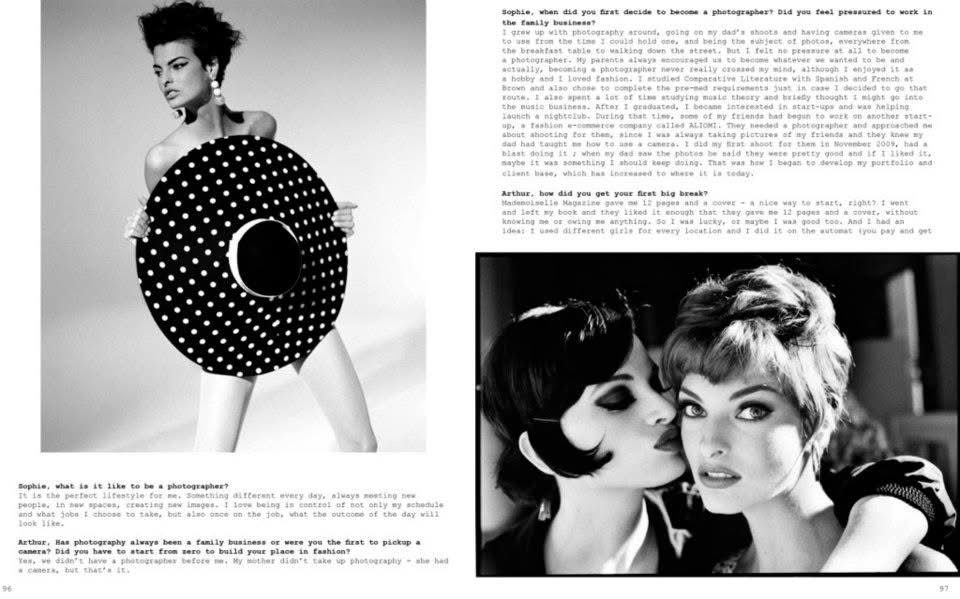
Arthur Elgort and Sophie Elgort, father and daughter, on two generations of fashion photography. Text by Quentin Fears, who also styled the issue's cover story. The feature ran alongside Arthur's photographs, among them his portraits of Christy Turlington and Linda Evangelista.
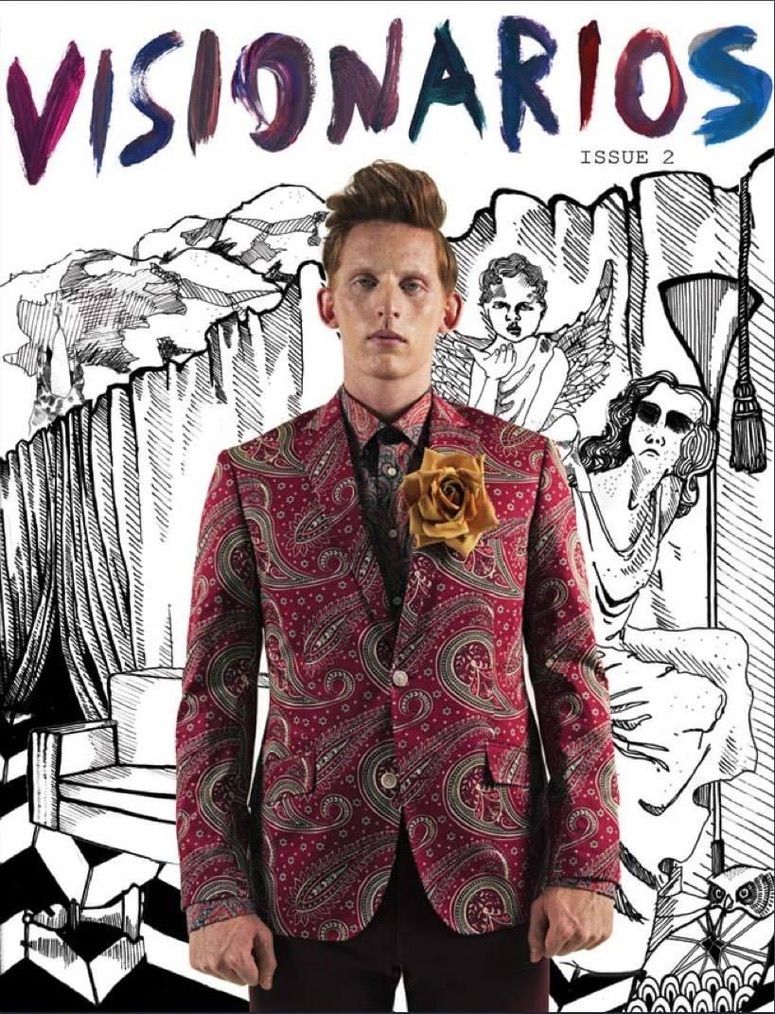
From the magazine
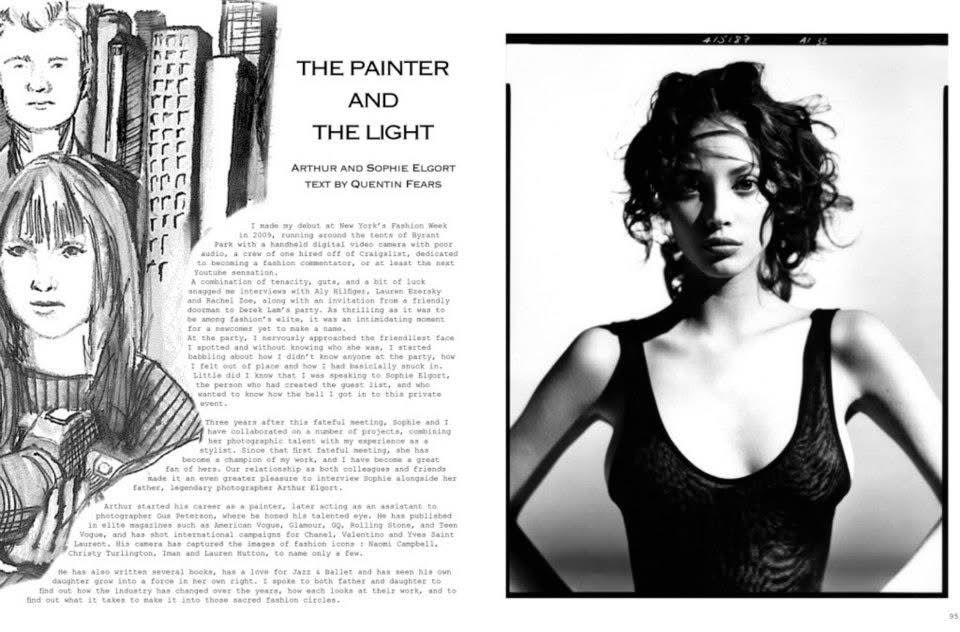
I made my debut at New York's Fashion Week in 2009, running around the tents of Bryant Park with a handheld digital video camera with poor audio, a crew of one hired off of Craigslist, dedicated to becoming a fashion commentator, or at least the next YouTube sensation. A combination of tenacity, guts, and a bit of luck snagged me interviews with Aly Hilfiger, Lauren Ezersky and Rachel Zoe, along with an invitation from a friendly doorman to Derek Lam's party. As thrilling as it was to be among fashion's elite, it was an intimidating moment for a newcomer yet to make a name.
At the party, I nervously approached the friendliest face I spotted and, without knowing who she was, I started babbling about how I didn't know anyone at the party, how I felt out of place and how I had basically snuck in. Little did I know that I was speaking to Sophie Elgort, the person who had created the guest list, and who wanted to know how the hell I got in to this private event.
Three years after this fateful meeting, Sophie and I have collaborated on a number of projects, combining her photographic talent with my experience as a stylist. Since that first meeting, she has become a champion of my work, and I have become a great fan of hers. Our relationship as both colleagues and friends made it an even greater pleasure to interview Sophie alongside her father, legendary photographer Arthur Elgort.
Arthur started his career as a painter, later acting as an assistant to photographer Gösta Peterson, where he honed his talented eye. He has published in elite magazines such as American Vogue, Glamour, GQ, Rolling Stone, and Teen Vogue, and has shot international campaigns for Chanel, Valentino and Yves Saint Laurent. His camera has captured fashion icons Naomi Campbell, Christy Turlington, Linda Evangelista, Iman and Lauren Hutton, to name only a few.
He has also written several books, has a love for jazz and ballet, and has seen his own daughter grow into a force in her own right. I spoke to both father and daughter to find out how the industry has changed over the years, how each looks at their work, and what it takes to make it into those sacred fashion circles.
Sophie, what is it like to be a photographer?
It is the perfect lifestyle for me. Something different every day, always meeting new people, in new spaces, creating new images. I love being in control of not only my schedule and what jobs I choose to take, but also, once on the job, what the outcome of the day will look like.
Arthur, has photography always been a family business, or were you the first to pick up a camera? Did you have to start from zero to build your place in fashion?
Yes, we didn't have a photographer before me. My mother didn't take up photography. She had a camera, but that's it.
Sophie, when did you first decide to become a photographer? Did you feel pressured to work in the family business?
I grew up with photography around, going on my dad's shoots and having cameras given to me to use from the time I could hold one, and being the subject of photos, everywhere from the breakfast table to walking down the street. But I felt no pressure at all to become a photographer. My parents always encouraged us to become whatever we wanted to be and actually, becoming a photographer never really crossed my mind, although I enjoyed it as a hobby and I loved fashion.
I studied Comparative Literature with Spanish and French at Brown and also chose to complete the pre-med requirements just in case I decided to go that route. I also spent a lot of time studying music theory and briefly thought I might go into the music business. After I graduated, I became interested in start-ups and was helping launch a nightclub. During that time, some of my friends had begun to work on another start-up, a fashion e-commerce company called ALIOMI. They needed a photographer and approached me about shooting for them, since I was always taking pictures of my friends and they knew my dad had taught me how to use a camera.
I did my first shoot for them in November 2009 and had a blast doing it. When my dad saw the photos he said they were pretty good, and if I liked it, maybe it was something I should keep doing. That was how I began to develop my portfolio and client base, which has grown to where it is today.
Arthur, how did you get your first big break?
Mademoiselle Magazine gave me 12 pages and a cover. A nice way to start, right? I went and left my book and they liked it enough that they gave me 12 pages and a cover, without knowing me or owing me anything. So I was lucky, or maybe I was good too.
And I had an idea: I used different girls for every location, and I did it at the automat (you pay and get your food), Katz's Deli, and other food shops around the city. And I used my own girls too, who I knew because I was already working with them. Mademoiselle liked the idea, and Bonnie Lysohir made the cover, and is still a good friend. The editor was Deborah Turbeville, who is a famous photographer now. They thought photography was a skill back then, but now they ask more questions.
During the same time Glamour wanted to give me nurses' uniforms to shoot on just a quarter of a page, so I thought, you know what, I'm going to take the other one.
Sophie, growing up with fashion all around you, how did it affect your point of view and the way you see the world?
I always thought it was a normal way to grow up. I never thought much about it. I had a pretty balanced life and I was always trying new things: white water kayaking camp in the summers, learning to play classical piano, and ski racing from the time I was 8 years old. When I was 14 I moved up to Vermont full time to attend a ski racing academy for high school, where I competed internationally, and then I raced for Brown University.
So while I was surrounded with fashion, images and photography, and although I did internships in the summers all through high school in different areas of the industry, I don't feel like fashion was the one influential force that determined my point of view of the world. There were many contributing factors, and I think (hope!) that now that I am a professional photographer, all of those experiences have given me a unique point of view.
And how do you describe your approach to fashion photography?
I would say that I focus on capturing the personality of whoever I'm photographing. That is the most important thing to me, because it keeps the photo looking authentic. I definitely learned that from my dad, and use his method of chatting constantly with the subject while shooting them to put them at ease and bring out their true personality. What does their laugh really look like? How do they walk down the street?
Then I focus on the composition of the photo, creating a nice frame, and finally I make sure that the clothes look good and that the person's body looks good. I don't like people to look overly posed. I like to create scenarios for the subject and then capture whatever they do within the scenario, almost as if I were photographing a skit. I like to tell the individual stories of the people I photograph.
Arthur, how do you feel when you see your daughter's work?
Very good, because she's good. And I think she's going to be in the next wave of important photographers, and if she wasn't, I would be the first person to tell her to go to medical school. Of course, sometimes I see something and I say, "Oh, on that shot you should have gotten further down on your knees," etc. And Sophie is good at styling because she knows the clothes. She is also fast, as I am.
And Sophie?
I love my father's work, all of it, and I am so proud of him and in awe of his talent and the images that he has produced throughout the years. I am proud to be his daughter.
Arthur, how has fashion changed over the years? Are you feeling nostalgic for the older days?
I think no one should show up sometimes except the model, and sometimes the model can do it herself. There are too many people on set. Also, we used to get to pick the models, and that's not the way it is anymore. In the '70s and the '60s, it was good, it was different. Now there are too many people making decisions on a shoot. Plus, everybody's a photographer now.
Sophie, do you ever shoot on film?
Only as a hobby. I don't usually use film when I'm on a job. The clients usually need the photos too quickly, sometimes even the day after.
Arthur, what do you think about digital photography? Is there something that you can only create when shooting on film?
Yeah, 4x5 is better than digital, because it's bigger, you see more. But I think digital photography is good, I use it. I like my small digital camera because I see what I'm doing on it and realize when I have to go lower or higher, which you can't do with film.
Arthur, do you still work with film?
Once in a while people request film, but most people want digital because they want to check what you've done. Sometimes people prefer I use a larger camera, like a Rolleiflex or a Hasselblad or a 4x5, but it's a bit harder to use after my stroke, so I am kinder to digital because I need it more.
Sophie, what is your favorite image that you have produced?
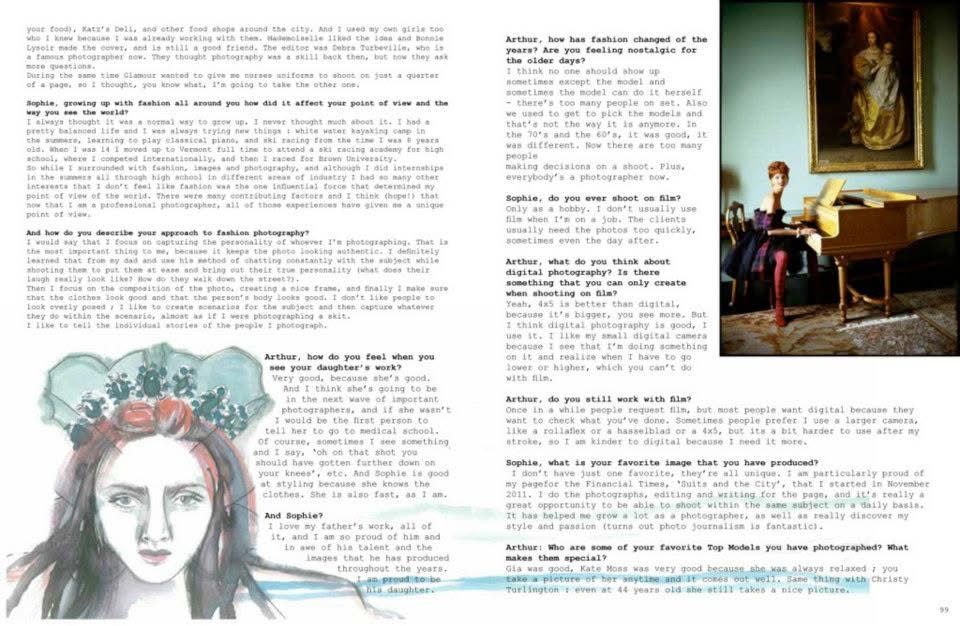
I don't have just one favorite; they're all unique. I am particularly proud of my page for the Financial Times, "Suits and the City," that I started in November 2011. I do the photographs, editing and writing for the page, and it's really a great opportunity to be able to shoot within the same subject on a daily basis. It has helped me grow a lot as a photographer, as well as really discover my style and passion (turns out photojournalism is fantastic).
Arthur, who are some of your favorite top models you have photographed? What makes them special?
Gia was good. Kate Moss was very good because she was always relaxed: you take a picture of her anytime and it comes out well. Same thing with Christy Turlington: even at 44 years old she still takes a nice picture. Cindy Crawford always looks good in photos. And Karlie Kloss is my favorite model of this generation.
Sophie, are you inspired by your father's work? Do you feel any particular attachment to fashion work from the '80s and '90s?
Yes, I am inspired by a lot of his work, and mostly how he makes his subjects move in his photos. I have his work from the '80s and '90s all over my walls, and his book, Models Manual, is a frequent source of inspiration.
Arthur, how have your life experiences affected your art? From growing up in Washington Heights and studying painting at Hunter College, to working as a painter and later a photographer, what are the differences and similarities?
I chose photography because I liked it better. I was a good painter, but I could never paint hands. I knew that I wasn't a natural, and when I saw Henri Cartier-Bresson's books at a friend's house I decided that I wanted to do what he did. I was not great at expressing myself through painting, but I felt I could do it through photography.
I also like the social aspects of it, being able to talk to people. When you're painting, you're alone and there is no one around to talk to. But when I went to school for photography at Hunter College, there were perhaps 4 photographers in the whole school out of 3,000 kids.
Sophie, in what direction do you see your work heading?
I'd like to keep trying new things, to figure out different ways to capture people. I am thinking about taking on a personal photography project in the near future, photographing people and their surroundings within a certain genre and doing interviews with them too. I also want to start doing video and film as well.
Arthur, at Visionarios Magazine, we are dedicated to honoring and producing analog photography. What do you think of this pursuit? Is there still a place for analog photography?
Yes, I think it will come back more and more, and that will be the difference between the real guys and the phonies.
And to conclude: what advice would you give Sophie, or any other young photographer starting out in the business?
Good luck. There are too many photographers now and it's too easy, so you have to do something else to differentiate yourself. If I were Sophie I would also back it up with writing and film a little bit. I would look for something else, because you have to be versatile now and you have to use your imagination.
Originally published in Visionarios Magazine, Issue 2, as "The Painter and the Light: Arthur and Sophie Elgort," text by Quentin Fears.
Conversations like this one, on stage.
I bring the same curiosity to panels, interviews, and hosting.
Speaking & hosting →